How Neighbours Shared Local News Before Noticeboards
How neighbours shared local news before noticeboards reveals how errands, familiar places and spoken messages carried community memory from one household to another.

A folded note waits beside the bread bin, ready for someone to take next door. How neighbours shared local news before noticeboards depended on familiar routines: a doorstep chat, a shop visit or an item being returned. The details varied from place to place, but the everyday routes help explain how information became part of local memory.
What kinds of news travelled between neighbours?
A message might concern a missing key, a change to a shared path, a school event or a neighbour in need of help. Some news required action; other details were passed on because they mattered to people who lived nearby.
There was no firm line between an announcement and a conversation. Someone returning a borrowed tin might mention a gathering and ask the listener to tell another household. The news travelled as part of an exchange that was already taking place.
Where did neighbours pass messages?
People used places and moments they already shared. A quick word at the door suited nearby households. A shop counter brought customers into contact, while a note tucked into a returned parcel could follow an item from one home to another. Regular gatherings gave people time to explain details aloud.
- Doorways: A short conversation could share an update with someone who happened to be home.
- Shops and service counters: Customers might hear the same news during ordinary visits.
- Errands and borrowed items: A message could travel alongside something already being carried between homes.
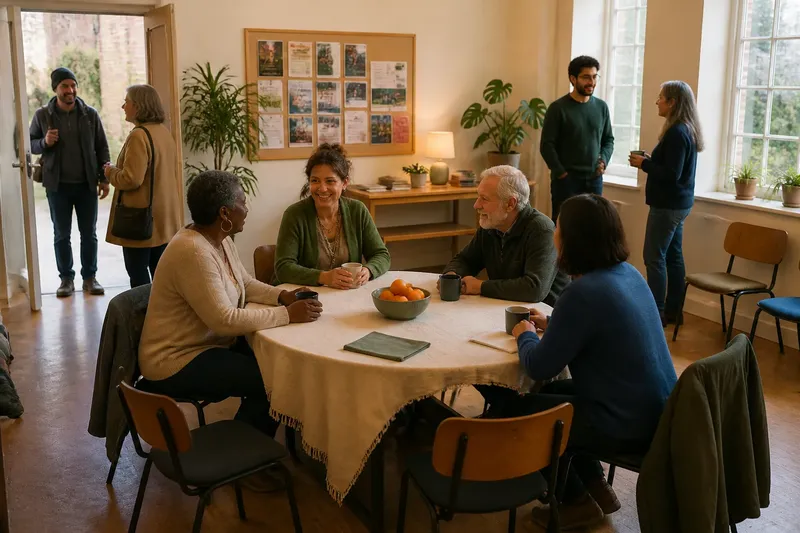
- Gatherings and shared tasks: People could raise a topic, hear questions and add context.
Each route had limits. Spoken news could be quick, but only reach people who met the messenger. A written note could wait for its recipient, yet be misplaced or lack a clear explanation. A neighbour passing on the message could add helpful context, but might also change a detail without meaning to.
Why did some neighbours hear later than others?
News often followed existing contact. People who visited the same shop or took part in the same activity had more chances to hear it. Someone who had recently moved in, kept different hours or rarely met the usual messengers might find out later.
This could happen without anyone intending to leave a neighbour out. A person told the next person they encountered, who told someone else. The message followed habit, not necessarily the full shape of the neighbourhood.
Timing mattered as well. A conversation during a morning errand could pass by people who were at work, caring for someone or unable to leave home. Neighbours might each believe that “everyone knows”, while meaning only the people in their own circle.
How could a message change as it travelled?
At each handoff, someone had to remember and retell the details. A listener might keep the date but forget the place. A tentative plan could sound settled, or a guess about the reason for a change could be repeated as fact.
Imagine a resident hears that a shared lane will be unavailable one afternoon. They mention it while returning a borrowed basket, and the next neighbour tells a household at the corner. If the neighbour says the lane will be closed all day, the household may plan around the wrong timing. A note from the organiser naming the afternoon and a contact for questions would help them check the detail.
Conversation could also supply information a short notice lacked: why a path was blocked, who could answer a question or whether children could attend an event. That explanation depended on having someone to ask and feeling comfortable enough to do so.
What helped neighbours check the details?
When a message affected plans, people could ask its source rather than pass on a hazy recollection. They might speak to the organiser, check a note at a familiar meeting place or repeat the details back to the person who shared them.
- Check the source: If the organiser is named, ask them about uncertain details; if no source is known, describe the message as unconfirmed rather than presenting it as settled.
- Check the date and place: If both are clear, pass them on together; if either is missing, ask before someone makes plans.
- Check what has changed: If the message distinguishes a proposed plan from a confirmed one, keep that distinction; if it does not, confirm the status with the person responsible.
- Check what the listener needs to know: If the message affects access or timing, share the relevant detail directly; if it is only a passing remark, keep the exchange informal.
- Check whether the usual route reaches the person: If a neighbour is unlikely to meet the messenger, use a route they already encounter; if no suitable route is known, ask them how they prefer to hear practical updates.
- Check whether a retelling has added a guess: If a detail comes from the original message, pass it on as stated; if it is an inference, identify it as uncertain or leave it out.
It is not worth turning every casual remark into a formal announcement. That can make small exchanges cumbersome. A little extra care matters most when the message affects a shared decision, someone’s access or the timing of an event.
How neighbours shared local news before noticeboards: what should we remember?
Did every neighbourhood use the same way to share news?
No single route fits every place or period. The useful point is that messages often travelled through local routines, such as visits, errands and gatherings, rather than through one universal system.
Why could spoken news be useful?
A person could explain a detail and answer a question as they passed the message on. The same chain could also lose or alter information as it moved between people.
Why might someone miss a message?
They might not share the messenger’s routine, be at home at the right time or know the people involved. A message reaching one familiar circle did not mean the whole neighbourhood had heard it.
What is the difference between a conversation and a public notice?
A conversation can carry personal context and invite an immediate reply. A public notice can make information visible to people outside the speaker’s usual circle, though it may offer less explanation.
Local news before the noticeboard was not one settled tradition with the same rules everywhere. It was a set of ordinary exchanges shaped by the people, places and routines involved. That distinction matters when recalling a story: ask who passed it on, where it was heard and which details came from the original source. Those questions preserve the route of the news as well as its message.